sensuous imagination: J. Hillman, “Once More Into the Fray.” Spring 56. (Fall 1994). Reply to Wolfgang Giegerich’s, “Killing: Psychology’s Platonism and the Missing Link to Reality.” Spring 54. (1993)
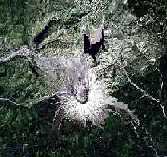
Mount St. Helens: "The new Landsat 7 satellite is now taking high resolution images of the Earth. This 1999 press release picture shows Mt. St. Helens. The green is forest and fields, the white is glaciers and snow, and the grey shows areas destroyed by flowing ash in the 1980's eruption that have still not recovered their vegetation covering. Spirit Lake is still partly covered by floating logs." Image by EROS Data Center, Sioux Falls, SD. http://volcano.und.nodak.edu/vwdocs/volc_images/img_st_helens.html
Ape Cave: Located by the south slope Mount St. Helens, Ape Cave is the “epicenter of Bigfoot myth.” R.M. Pyle, Where Bigfoot Walks. Boston, MA., 1995. P.11. Formed about 2,000 years ago, at two miles in length it is one of the longest lava (pathoehoe) tubes in the world. The cave is inside and out, dream and function, ritual and discovery. There are no borders but flickering shadows and the labyrinth, the turning, the tunnel in which imagination crawls through.
maw: "The primitive beast that lingers within man has certain deep dreads, beyond logic, beyond intelligence. He dreads the dark. He fears being underground, which place he has always called the home of evil forces. He fears being alone. He dreads being trapped. He fears the water from which, in ancient times, he emerged to become Man. His most primitive nightmares involve falling through the dark, or wandering lost through mazes of alien chaos.” Trevanian, Shibumi. New York, 1979. p.191.
Plato's Cave: “The tradition of caves as the antechamber of the classical underworld, the land of the dead, a halfway point from which to contact the gods in their separate reality, was firmly entrenched from archaic times. Before the advent of what Peter Kingsley has dubbed the ‘aetherial’ model of Plato’s cave (a World of Forms preceding and informing the shadowy reality we perceive through the senses), pre-Socratic Greek philosophy was rooted in a tradition of seeking wisdom in the darkness, not the light, via dream incubation in caves. Initiates who slept in these sacred places journeyed to the realm of the dead in hope of meeting a divinity who would become their friend and mentor. Unlike Parmenides and Empedocles, whose cults, like many others in the ancient world, offered the cave as a place of healing and connection to a transcendental world outside the senses, Plato would present the cave as a parable for the limitation of perception derived solely from sensory experience---hence a place the exceptional person is obliged to escape from if he is to perceive truth.” V. Nelson, The Secret Life of Puppets. Cambridge, MA., 2001. p.3.
Colossus's: “Colossus is a graffiti artist whose work can be seen on railway cars around the country. It's rumored that he's a rail worker. ‘He's just a guy,’ says Obscura (a photographer who documents the art of hobos and rail workers). ‘A guy who's out there, wearing his overalls, his hat, working the rails, and leaving his mark.’ Portland Mercury. July 13-19 2000. p.11.
footprints: "On a divide between two watersheds I came upon the scene of a battle between a moose and three wolves. The story was written plainly in the snow at my feet...What might have been silence, an unwritten page, an absence, spoke to me as clearly as if I had been there to witness it. I have imagined a man who might live as the coldest scholar on earth, who followed each clue in the snow, writing a book as he went." J. Haines, From, The Stars, the Snow, the Fire.